
Guests Book Experiences, Not Floor Plans: Why Your Listing Needs to Feel Real
When a guest opens a listing, they are not evaluating square footage. They are deciding whether they can already feel themselves there.
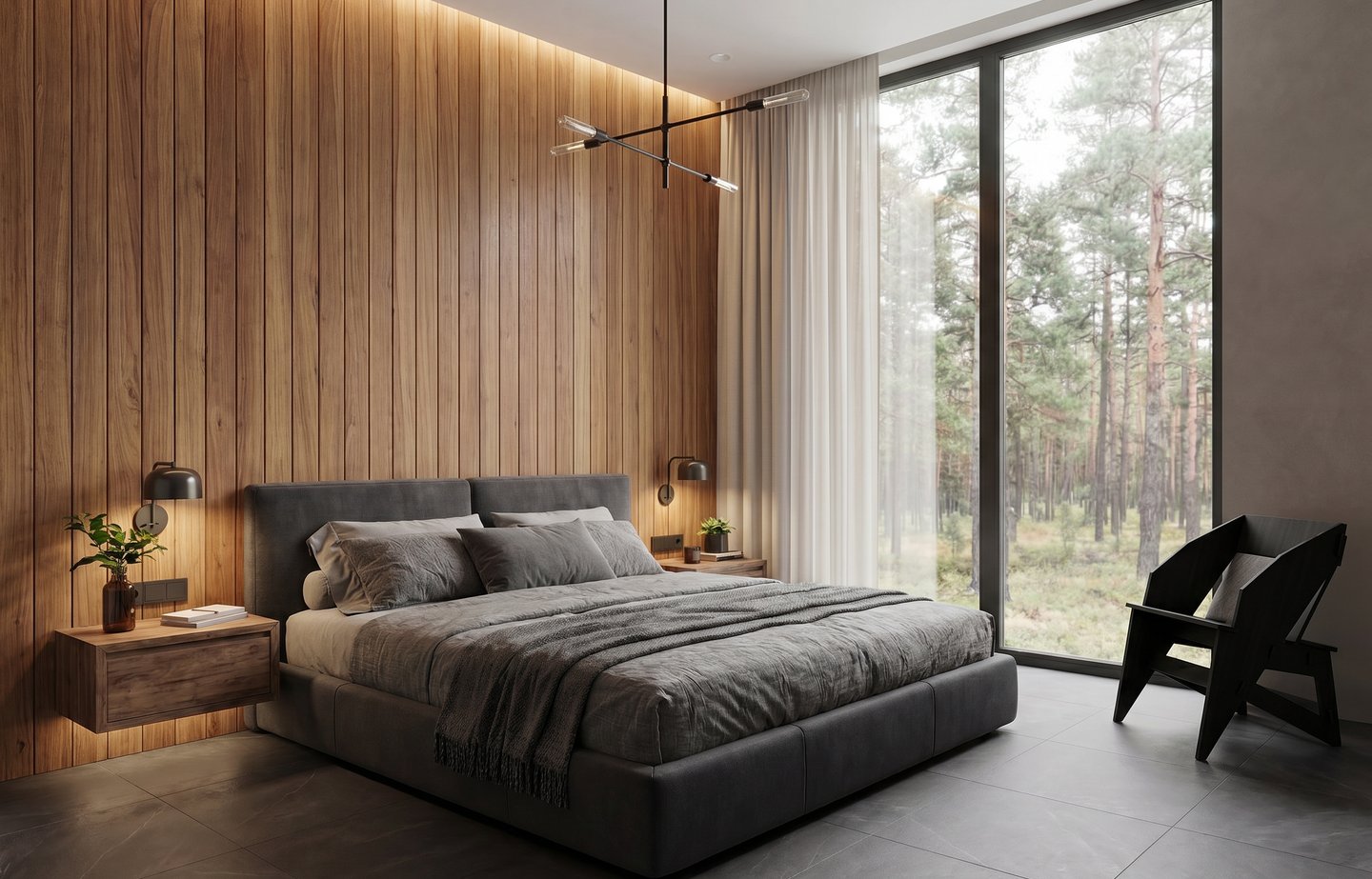
When a guest opens a listing, they are not evaluating square footage. They are deciding whether they can already feel themselves there.
That distinction changes everything about how a pre-construction or pre-renovation property needs to be presented. A guest browsing Airbnb or a direct booking site is running an emotional test in under thirty seconds: does this place feel real, does it feel worth the price, and can I picture my specific version of a good trip happening inside it. A floor plan fails that test not because it's inaccurate, but because it's the wrong language for the decision being made.
Why Guest Booking Decisions Are Emotionally Driven
Hospitality guests do not book accommodations. They book the anticipation of an experience. The cabin in the mountains with the rainfall shower and the view from the bed, the boutique suite with the terrace, the lakeside retreat that their group has been talking about since January, these are not purchases driven by specification review. They are driven by feeling, and that feeling has to land before the booking does.
The operators who understand this structurally outperform the ones who don't. A well-documented case in the STR world is Tanner and Melissa, a couple who bought a wooded plot in North Georgia with a fifty-foot waterfall on it and set out to build a micro-resort before a single structure existed. Following the playbook shared publicly by STR educator Isaac French, they ran a targeted advertising campaign, collected thousands of email leads, and pre-sold stays to founding members at a rate of $50 deposits per person. Before breaking ground, they had raised north of $650,000 in pre-bookings, sold out 83% of their first year at an average daily rate of $640, and essentially used their early guests to fund the proof of concept. The land was wooded. The waterfall was real. Everything else, the cabins, the experience, the feeling of arriving there, existed only in how they communicated the vision.
That is a visualization problem. And it is the same problem every pre-construction and pre-renovation STR operator is sitting with, whether they recognize it as such or not.
What Cinematic Film and Still Renders Communicate That a Floor Plan Can't
A floor plan is useful for one audience: the team building the thing. It communicates structural relationships, dimensions, and flow to people trained to read it. No guest is that audience.
Photoreal still renders take the same spatial information a floor plan contains and translate it into the language a guest actually thinks in: what does this room look like, what does the light do in the morning, what will I see when I open the door to the bedroom. A well-executed still doesn't ask a guest to imagine. It shows them, with the same fidelity they'd expect from a photograph of a property that's already been built, photographed, and published.
Cinematic film goes further by doing something a still set cannot: it moves. A guest watching a short, well-paced walkthrough of a property that doesn't exist yet experiences a sequence, arrival, first impression, the way the main living space opens, the detail of a finish, the outdoor view. That sequence is not accidental. It's built to produce a specific emotional impression in a specific order, the same way a strong listing photograph isn't accidental but is composed to show the space at its best. Film does that composing across time, not just within a single frame, which is why it converts differently than stills even when the underlying property is identical.
Using Visualization to Convert Browsing Into Early Bookings
Pre-booking is not a new concept, but most STR operators treating it as a financing mechanism are missing the larger point: it is a trust mechanism first. A guest who pre-books a stay at a property that doesn't exist yet is not doing so because a floor plan convinced them. They are doing so because the operator communicated enough of the experience clearly enough that the guest decided to bet on it.
That bet requires visual evidence of what is coming. Not renderings that look like illustrations. Not site photos of raw land or scaffolding. Renders and film that feel like the place is already real, already waiting for them, already worth the price they're being asked to pay in advance.
The operators who unlock pre-booking revenue at meaningful scale are the ones who treat visualization not as a post-construction marketing step but as the instrument that makes pre-construction trust possible. You are not asking a guest to imagine a property. You are showing them one.
Story-Driven Film Versus Straightforward Documentation
This is where most hospitality operators make the same mistake, and it's worth being direct about it: a walkthrough that documents a property is not the same thing as film that sells a stay.
Documentation answers the question "what is here." It is a complete tour, every room, every angle, methodical and thorough. It is also, in our experience, almost always the wrong tool for converting a guest who is still browsing. A guest in browsing mode is not running a checklist. They are asking whether they feel something, and thoroughness does not produce feeling. Pacing does. Selection does. The decision to show three things beautifully rather than twelve things completely is a creative and strategic choice that separates listing film that converts from listing film that merely informs.
Story-driven film for a hospitality property works like a well-written opening paragraph. It pulls a specific person in, it creates a want, and it ends before it overstays its welcome. The property is the subject, but the guest's imagination is what the film is actually activating. A walkthrough that shows every closet and every ceiling fan is not doing that work. A sixty-second film that opens on a dawn exterior, moves through the main space at the pace of someone arriving for the first time, and closes on the view a guest will wake up to, that is.
We are also developing an AI-assisted cinematic workflow specifically for hospitality operators who need this kind of story-driven film at a faster production pace, particularly for properties in early-stage development where speed to market is part of the competitive advantage. It is not something we are scaling broadly yet, but for operators whose timeline makes it relevant, it is worth a conversation.
What to Provide a Studio to Start
Pre-construction visualization does not require a finished property, or even a complete set of drawings. What it requires is enough design intent to build from accurately.
Useful starting materials include architectural drawings or preliminary floor plans, any design inspiration, mood boards, or finish selections that have been made, site photographs that establish the setting and orientation, and a clear sense of who the target guest is and what the booking listing needs to communicate to them. The more complete the material, the more efficient the production process, but early-stage projects with incomplete drawings are workable starting points, particularly when the goal is capturing guest interest ahead of construction rather than documenting a finished property after it.
FAQs
How Early Before Opening Should I Start Pre-Booking Visualization?
As early as design intent is clear enough to build from accurately, which is often well before construction begins. For operators pursuing a pre-booking strategy, the visualization needs to exist before the campaign goes live, not after. Working backward from a launch date, most projects benefit from beginning visualization production three to six months before the intended booking window opens, though compressed timelines are possible when source material is complete and direction is locked early.
Do Guests Respond Better to Film or Stills?
Both, for different moments in the booking journey. Stills carry the listing itself, they are what a guest sees first in a search result and what anchors the first impression. Film does its work once a guest has clicked through and is spending real time with the property, and it tends to be the asset that converts a browsing guest into a booking guest when the experience is communicated well. For most pre-construction properties, a still set paired with a short story-driven film is the strongest combination, with stills handling discovery and film handling conversion.
Can I Use Visualization Assets Directly on Booking Platforms?
Yes, and this is underused. Photoreal renders are indistinguishable from professional photography at the resolution booking platforms publish at, which means a property can have a fully realized, polished listing presence before construction is complete. The renders function exactly as photography would, as the primary images in a listing, as assets for a direct booking site, and as content for the social and email campaigns that drive traffic to the listing in the first place. The only practical consideration is being transparent in listing copy that images are pre-construction renderings, which most platforms recommend and most guests at this end of the market respect when the quality is clearly high.
Start With Your Opening Date
The operators who fill their first season before they open are not doing something fundamentally different from the ones who wait. They are just making the experience legible earlier. If you have a property opening in the next six to eighteen months and an early-booking window you want to fill, that is exactly the conversation this call is built for. Book thirty minutes and we'll work backward from your opening date.
Decision-influencing visualization for architecture, real estate, and luxury brands.
Remote · Worldwide
© 2026 Vision Flow.
Vision flow studios is a wholly owned subsidiary of KHALIQ DESIGN STUDIOS Ltd Liability Co.

